

If you have a website and you want people to find it on Google, you need SEO.
Search engine optimisation (SEO) is the practice of improving your website so it ranks higher in search engine results, without paying for ads. When someone searches “best project management software” or “how to remove a stripped screw,” the websites that appear at the top did not get there by accident. They earned those positions through deliberate SEO work.
This guide explains what SEO is, how it works in 2026, and what you actually need to do to rank. Whether you are a business owner, a marketer, or just getting started, this is the foundation you need.
What Is SEO?
SEO stands for search engine optimisation. It is the process of making your website more visible in organic (non-paid) search engine results pages, commonly called SERPs.
The goal of SEO is to attract relevant traffic, people who are actively searching for what you offer. Unlike paid advertising, organic search traffic does not stop the moment you stop spending money. Done well, SEO compounds over time.
Search engines like Google, Bing, and now AI-powered tools like Perplexity and ChatGPT all use algorithms to decide which content is most useful for any given query. SEO is the discipline of understanding those algorithms and aligning your content, site structure, and authority with what they reward.
Quick definition: SEO = making your website easier for search engines to find, understand, and trust — so they rank it higher and show it to more people.
Why SEO Matters in 2026
Organic search remains one of the highest-ROI marketing channels available. Here is why it still matters, and arguably matters more than ever:
Search volume is enormous. Google alone processes over 8.5 billion searches per day. A top-three organic ranking for a relevant keyword can drive significant, consistent traffic to your site at no ongoing cost.
AI search is growing fast. AI-generated answers from tools like Google AI Overviews, Perplexity, and ChatGPT now appear prominently in search results. The sources cited in these AI answers are largely determined by traditional SEO signals, authority, topical relevance, and content quality. Ranking well in traditional search increasingly means appearing in AI-generated summaries too.
Paid ads have their limits. PPC (pay-per-click) advertising delivers immediate traffic but can be expensive and competitive. SEO builds a long-term asset. Many businesses find that SEO delivers a lower cost per acquisition over the long run.
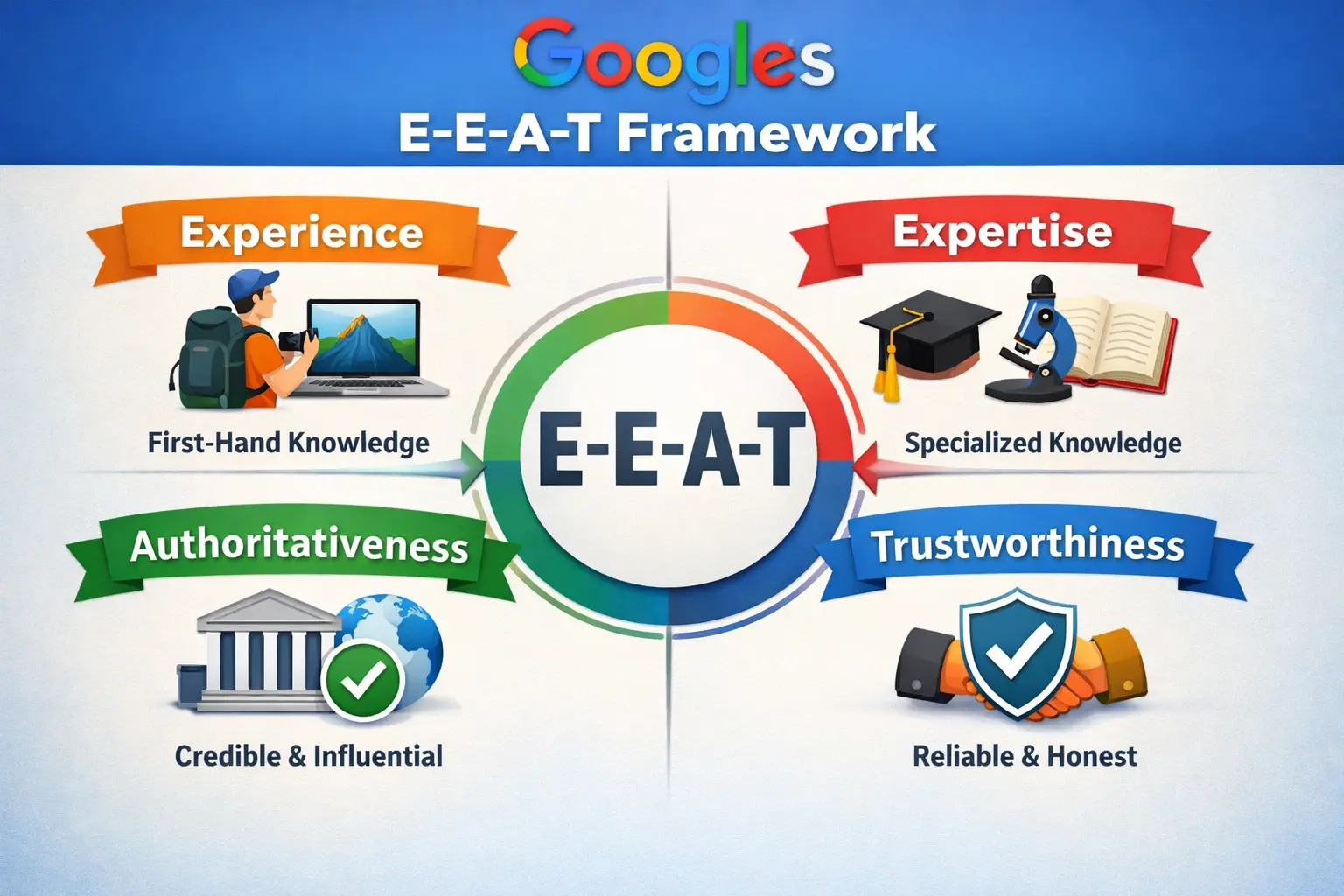
Trust is a ranking signal. Google’s E-E-A-T framework (Experience, Expertise, Authoritativeness, Trustworthiness) means that sites demonstrating genuine expertise and real-world credibility rank better. This rewards legitimate businesses that invest in quality.
How Search Engines Work
To understand SEO, you first need to understand what search engines are actually doing.
Crawling
Search engines use automated bots (called crawlers or spiders) to discover web pages. These bots follow links from one page to the next, building a map of the internet. If search engines cannot crawl your pages, because of broken links, blocked files, or crawl budget issues, your content will not get indexed.
Indexing
Once a crawler visits a page, the search engine processes and stores it in its index, a massive database of web content. Indexed pages are eligible to appear in search results. Pages that are blocked, marked as noindex, or have significant quality issues may be excluded.
Ranking
When someone performs a search, the search engine retrieves relevant pages from its index and ranks them in order of likely usefulness. Hundreds of ranking factors influence this order, broadly grouped into:
- Relevance — does your content match the intent behind the query?
- Authority — does your site have credibility signals like quality backlinks?
- Quality — is the content well-written, accurate, and genuinely helpful?
- Technical health — is the site fast, mobile-friendly, and properly structured?
The Three Pillars of SEO
SEO is typically divided into three interconnected areas: on-page SEO, off-page SEO, and technical SEO. Strong results require attention to all three.
1. On-Page SEO
On-page SEO covers everything you control directly on each page of your website. The goal is to make it easy for both users and search engines to understand what your page is about and why it is the best result for a given query.
Key on-page SEO elements:
Title tags — The clickable headline that appears in search results. Each page should have a unique, descriptive title that includes the target keyword near the front. Keep it under 60 characters to avoid truncation.
Meta descriptions — The short summary beneath the title in search results. Not a direct ranking factor, but a well-written meta description improves click-through rates. Aim for 150–160 characters with a clear benefit and a soft call to action.
Headings (H1–H6) — Use one H1 per page (usually your main title), then H2s and H3s to organise subsections. Headings help search engines understand your content structure and help users scan the page.
Content quality and depth — Google rewards content that satisfies search intent completely. This means covering the topic thoroughly, using natural language, incorporating semantically related terms, and providing genuine value. Thin, generic content does not rank in competitive spaces.
Keyword placement — Use your primary keyword in the title, first paragraph, at least one heading, and naturally throughout the body. Avoid keyword stuffing, write for humans first.
Internal linking — Link to related pages within your own site. This helps search engines discover your content, distributes authority across pages, and keeps users engaged longer.
Image optimisation — Every image should have a descriptive alt attribute. Compress images to reduce file size without sacrificing quality. Use descriptive filenames (e.g., seo-audit-checklist.webp not IMG_4821.jpg).
URL structure — Keep URLs short, descriptive, and keyword-relevant. Use hyphens to separate words. A clean URL like /what-is-seo performs better than /page?id=482.
2. Off-Page SEO
Off-page SEO refers to signals outside your website that indicate your authority and trustworthiness. The most important off-page signal is backlinks.
Backlinks are links from other websites pointing to yours. Google interprets each quality backlink as a vote of confidence. A link from a respected publication in your industry carries far more weight than dozens of links from low-quality directories.
What makes a backlink valuable?
- The linking site is authoritative and relevant to your niche
- The link is editorially placed (not paid or spammy)
- The anchor text is natural and descriptive
- The page being linked to is high quality
Common off-page SEO strategies:
- Digital PR — Creating original research, data studies, or compelling stories that journalists and bloggers want to cite
- Guest posting — Writing articles for reputable sites in your industry with a link back to your own
- Link reclamation — Finding unlinked mentions of your brand and requesting a backlink
- Content-led link building — Publishing resources so useful that others naturally link to them (calculators, templates, comprehensive guides).
Beyond backlinks, other off-page signals include brand mentions, social signals, and your presence in industry directories and review platforms.
3. Technical SEO
Technical SEO ensures that search engines can efficiently crawl, index, and render your website. Even excellent content will underperform if your site has technical problems preventing Google from accessing it properly.
Core technical SEO areas:
Site speed and Core Web Vitals — Google uses Core Web Vitals as a ranking signal. The three metrics to focus on are:
- LCP (Largest Contentful Paint) — how quickly the main content loads (target: under 2.5 seconds)
- INP (Interaction to Next Paint) — how responsive the page is to user interactions (target: under 200ms)
- CLS (Cumulative Layout Shift) — how stable the page layout is (target: under 0.1).
Mobile-friendliness — Google uses mobile-first indexing for all sites. Your mobile experience is evaluated first. If your site is hard to use on a phone, your rankings will suffer.
HTTPS — Every page should be served over HTTPS. This is a confirmed ranking signal and a basic trust requirement.
Robots.txt and crawl management — Your robots.txt file tells search engine crawlers which pages to visit. Misconfigured robots.txt files can accidentally block important pages from being crawled.
XML sitemaps — A sitemap lists all the pages you want indexed. Submitting it through Google Search Console helps Google discover and prioritise your content.
Structured data (schema markup) — Adding JSON-LD schema to your pages helps Google understand your content more precisely and can unlock rich results (star ratings, breadcrumbs, sitelinks search boxes). Always use <script type="application/ld+json"> format.
Canonical tags — Use canonical tags to indicate the preferred version of a page when duplicate or near-duplicate content exists across multiple URLs.
Crawl budget — Large sites need to ensure that Google’s crawlers are spending their limited crawl budget on valuable pages, not low-value URLs like filtered pages or internal search results.
E-E-A-T: The Content Quality Framework
Since December 2025, Google’s E-E-A-T framework applies to all competitive queries, not just health or finance. Understanding it is essential for any site that wants to rank in a competitive niche.
E-E-A-T stands for:
- Experience — Does the author have first-hand, real-world experience with the topic? This is the hardest thing to fake and has become Google’s most important differentiator between human content and generic AI-generated text.
- Expertise — Does the author have formal knowledge, credentials, or demonstrated depth in the subject matter?
- Authoritativeness — Is the site or author recognised as a go-to source by others in the industry?
- Trustworthiness — Is the site transparent, accurate, and honest? This is the most heavily weighted factor.
How to improve E-E-A-T:
- Add detailed author bios with credentials and links to their profiles
- Include original examples, screenshots, case studies, and data, things only someone with real experience could provide
- Keep content updated with the current date of the last revision
- Be transparent about who publishes the content and why
- Earn backlinks from credible, relevant sources.
SEO vs. AEO: The New Landscape
Traditional SEO focuses on ranking in the blue links of search results. But in 2026, a growing share of search happens through AI-generated answers, summaries displayed before or instead of traditional results.
AEO (Answer Engine Optimisation) is the practice of optimising for these AI-generated responses. This includes:
- Structuring content in a clear question-and-answer format
- Using concise, authoritative definitions and explanations
- Covering topics comprehensively so AI systems can extract complete answers
- Building the site authority that AI engines use to decide which sources to cite
The good news: the fundamentals of strong SEO, quality content, authoritative backlinks, technical health, and genuine expertise, are the same signals that drive AI citation. Investing in SEO lays the foundation for AEO visibility too.
Local SEO
If your business serves customers in a specific geographic area, local SEO is a distinct priority.
Local SEO focuses on appearing in location-based search results, including Google’s “local pack” (the map results that appear for queries like “dentist near me” or “coffee shop Wellington”).
Key local SEO factors:
- A complete, accurate Google Business Profile with photos, hours, and services
- Consistent NAP (Name, Address, Phone number) across your website and all online directories
- Customer reviews on Google and other relevant platforms
- Location-specific landing pages for each area you serve
- Local schema markup (LocalBusiness type).
How Long Does SEO Take?
SEO is a long-term investment, not a quick fix. Most sites see meaningful results within three to six months of focused effort, though competitive niches can take longer.
The timeline depends on:
- Domain age and authority — newer sites typically take longer to build trust
- Competition — ranking for “what is SEO” is harder than ranking for “SEO for NZ orthodontist clinics”
- Content quality and publishing frequency — more high-quality content, published consistently, speeds up results
- Technical health — a well-structured site is easier for Google to crawl and index quickly
The best approach is to start now and compound your results over time. Sites that started SEO investment two years ago have a significant advantage over those starting today, but those starting today will have the same advantage over those who wait another two years.
Getting Started with SEO: A Quick Action Plan
If you are new to SEO, here is where to focus first:
- Set up Google Search Console — free tool that shows which keywords you rank for, crawl errors, and indexing status. This is your baseline.
- Do keyword research — identify the specific phrases your target audience searches for. Use free tools like Google Keyword Planner or Ahrefs’ free keyword tool to start.
- Fix technical basics — ensure your site is on HTTPS, mobile-friendly, and loads quickly. Run a free PageSpeed Insights check.
- Publish high-quality, intent-matched content — start with topics where you can genuinely provide better information than what currently ranks.
- Build internal links — as you add pages, link between related pieces of content.
- Earn backlinks gradually — focus on creating content worth citing, then promote it to relevant audiences.
- Track rankings and iterate — use a rank tracking tool to monitor progress and double down on what is working.
Frequently Asked Questions
What does SEO stand for?
SEO stands for search engine optimisation. It is the practice of improving a website’s visibility in organic (unpaid) search engine results.
Is SEO free?
Organic search traffic itself is free, you do not pay per click. However, effective SEO requires an investment of time, and often money spent on tools, content creation, and link building.
What is the difference between SEO and SEM?
SEO focuses on earning organic rankings. SEM (search engine marketing) is a broader term that includes both organic SEO and paid search advertising (PPC). Many marketers use SEM to refer specifically to paid ads.
How often should I update my SEO content?
Content in fast-changing niches should be reviewed every six to twelve months. Evergreen content (like this article) can be updated annually. Always update the “last reviewed” date so Google and users know the information is current.
Can I do SEO myself?
Yes, especially for smaller sites and local businesses. The fundamentals are learnable, and many effective tactics cost nothing beyond time. For competitive industries or larger sites, many businesses hire SEO specialists or agencies.
What is the difference between on-page and off-page SEO?
On-page SEO covers what you control on your own site (content, headings, internal links, technical setup). Off-page SEO covers external signals, primarily backlinks from other websites.
SEO is how you earn long-term visibility in search, and increasingly, in AI-generated answers. At its core, it comes down to three things: create genuinely useful content that matches what your audience is searching for, make sure search engines can find and understand it, and build credibility signals that demonstrate your authority.
The landscape is evolving fast. AI search is changing how people find information, and Google’s quality standards are higher than ever. But the fundamentals remain consistent: quality, relevance, and trust win.