
Answer Engine Optimisation (AEO) is the process of structuring and formatting your content so that search engines and AI-powered answer interfaces can extract and display your answers directly on the results page, without the user needing to click through to your site.
The term covers optimisation for traditional zero-click SERP features like Featured Snippets, People Also Ask (PAA) boxes, and Knowledge Panels, as well as newer AI-generated surfaces like Google’s AI Overviews, ChatGPT‘s browsing responses, and Perplexity answer cards.
If you’ve noticed that Google increasingly answers questions at the top of its results page rather than simply listing blue links, you’re witnessing AEO in action. The goal for content creators is to be the source those answers come from.
Why AEO Matters in 2026
Search behaviour has shifted dramatically. Studies consistently show that a significant portion of Google searches now end without a click, because the answer is displayed directly in the SERP. That number increases further when you factor in AI-powered search engines where the answer interface is the entire product.
For SEO professionals, this creates two simultaneous challenges:
Traditional keyword rankings are losing visibility. Being ranked number one no longer guarantees traffic if a featured snippet or AI Overview sits above your result and answers the query in full.
New ranking surfaces are emerging fast. ChatGPT, Perplexity, Google Gemini, and Grok all surface answers drawn from web content. If your pages are not structured for extraction, they will not appear in these results regardless of your domain authority.
AEO is how you adapt to both.
AEO vs SEO vs GEO: Understanding the Differences
These three terms are often used interchangeably, but they target different surfaces and require different tactics.
Traditional SEO targets organic blue-link rankings. Success is measured in keyword position, click-through rate, and organic traffic volume. The core levers are backlinks, technical health, E-E-A-T signals, and on-page relevance.
AEO (Answer Engine Optimisation) targets zero-click rich results within traditional search: Featured Snippets, PAA boxes, Knowledge Panels, and Sitelinks Searchbox. These features are displayed by Google’s standard search algorithm and have been around for years, but they require deliberate content structuring to win.
GEO (Generative Engine Optimisation) targets AI-generated summaries and citations in tools like Google’s AI Overviews, Perplexity, and ChatGPT with browsing enabled. GEO is the newer discipline and focuses on citability, brand authority signals, and llms.txt configuration.
In practice, a strong content strategy needs all three. A well-optimised article can simultaneously rank in position one, own a Featured Snippet, appear in a PAA box, and be cited in an AI Overview. These outcomes are not mutually exclusive; they reinforce each other.
The Four Core AEO Targets
1. Featured Snippets
A Featured Snippet is the boxed answer that appears at the very top of a Google SERP, above the organic results, for informational queries. It pulls a short excerpt, usually a paragraph, a list, or a table, directly from a ranking page.
Google selects Featured Snippets based on which result best answers the query intent in the most direct way. The page does not need to be ranked number one, but it typically needs to be on the first page.
How to optimise for Featured Snippets:
For paragraph snippets (the most common type for informational queries), the optimisation formula is straightforward. Place a direct, 40 to 55 word answer immediately after a heading that matches or closely mirrors the query. The answer should begin with the topic, for example “Answer Engine Optimisation is…”, use plain language, and avoid preamble like “In this article, we will explore…”
For list snippets, structure the content as an ordered or unordered HTML list directly under a question-phrased heading. Keep lists to between five and nine items, and keep each item short, under 12 words where possible.
For table snippets, use a proper HTML table with header rows and keep the column count to four or fewer. Tables work well for comparisons, pricing tiers, and specifications.
2. People Also Ask (PAA)
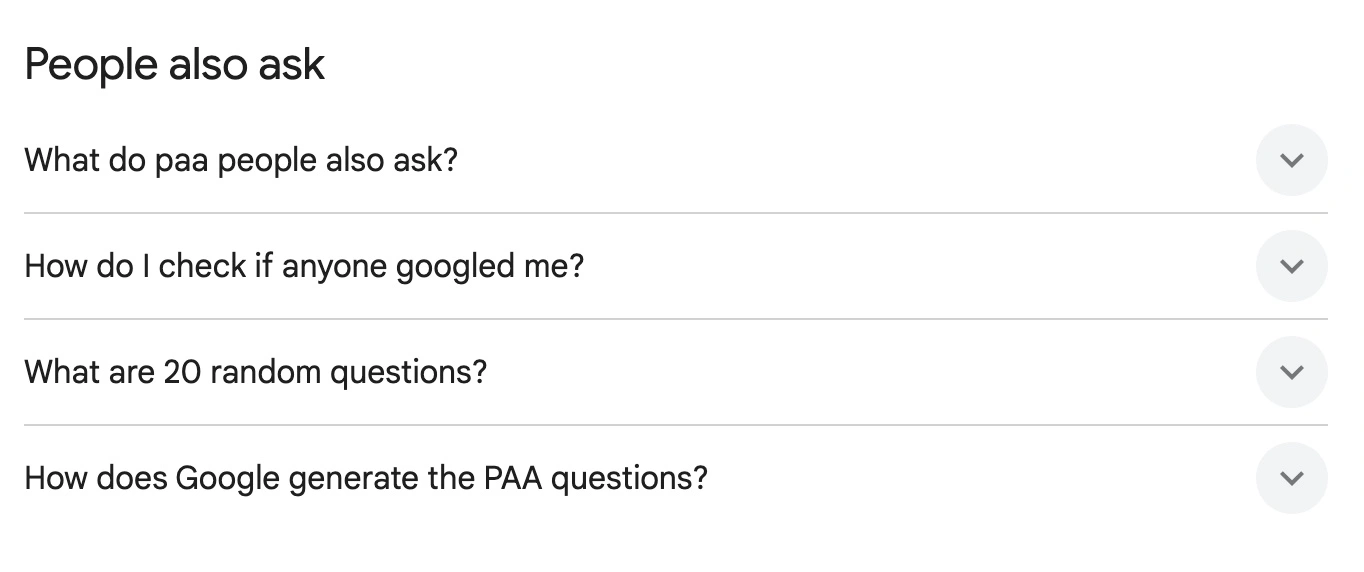
PAA boxes are the expandable question modules that appear throughout Google’s results pages. Each question, when clicked, expands to reveal a short extracted answer, and clicking one question typically causes more questions to populate below.
PAA is one of the highest-leverage AEO targets because a single page can appear in multiple PAA slots across different queries. For content-heavy sites and blogs, systematically optimising for PAA can significantly expand SERP real estate without requiring new pages.
How to optimise for People Also Ask:
Identify the PAA questions Google surfaces for your primary keyword. You can find these by searching your target keyword and manually noting which questions appear, or by using rank tracking and keyword tools to pull PAA data at scale.
For each relevant PAA question, create a dedicated H2 or H3 heading phrased as the exact question users are asking. Immediately below it, write a 30 to 50 word direct answer. Do not bury the answer in a larger paragraph, as the answer block needs to be immediately after the heading for Google’s parser to confidently extract it.
Avoid filler phrases at the start of PAA answers. Starting with “That’s a great question” or “There are many factors to consider” reduces your chances of selection. Start with the direct answer on the first line.
3. Knowledge Panels
Knowledge Panels are the information cards that appear on the right side of Google’s desktop results (and at the top on mobile) for entities: people, organisations, products, and brands. They are populated from Google’s Knowledge Graph, which in turn is informed by sources like Wikipedia, Wikidata, and structured schema data on your own site.
For most websites, Knowledge Panel optimisation means ensuring that your brand entity is clearly established and consistently described across the web.
How to optimise for Knowledge Panels:
Add Organisation or Person schema markup to your homepage using JSON-LD. Include a sameAs property that links to your profiles on Wikipedia (if present), LinkedIn, Twitter/X, and Crunchbase. This helps Google resolve your entity and associate all mentions of your brand name with a single, authoritative record. Ensure your brand name, description, and contact details are consistent across all platforms. Inconsistent naming, such as “SearchUp” on your site and “SearchUp Lab” on LinkedIn, creates entity disambiguation problems that delay or prevent Knowledge Panel attribution.
If your brand or key staff members do not yet have Wikipedia entries, focus on earning coverage in authoritative third-party publications. Google’s Knowledge Graph is heavily influenced by mentions in sources it already trusts.
4. Sitelinks Searchbox
When users search directly for your brand name, Google sometimes displays a search bar beneath your sitelink result that lets users search your site directly from the SERP. This feature is earned, not configurable but you can signal eligibility to Google.
To be eligible for a Sitelinks Searchbox, your site needs meaningful branded search volume and functional internal search. You also need to implement WebSite schema with a SearchAction property on your homepage, pointing to your internal search URL.
This is a lower-priority AEO target for most sites but is worth implementing once you have established brand search volume, as it directly increases SERP real estate for branded queries.
AEO and AI Search: The Expanding Landscape
Traditional AEO (Featured Snippets, PAA, Knowledge Panels) has been an established discipline for years. But the emergence of AI-powered search engines has expanded the definition significantly.
When a user asks Perplexity “what is the best rank tracker for AI search?” the platform does not return a list of links. It generates a synthesised answer and cites the sources it drew from. The same happens in Google’s AI Overviews and, increasingly, in ChatGPT with Browse.
Ranking in these surfaces requires a distinct but overlapping set of signals:
Structural clarity. AI models extract information from your pages similarly to how Google’s Featured Snippet algorithm does, by finding well-delimited answers near relevant headings. The same structural discipline that wins Featured Snippets also improves AI citation rates.
Brand mention density. AI systems learn which sources are authoritative partly from how often they are mentioned and cited across the web. Appearing regularly in industry publications, forums, and toolkits increases the probability of being cited in generative answers.
LLMs.txt file. A growing number of AI search platforms respect a standardised file at yourdomain.com/llms.txt that tells AI crawlers which parts of your site are most relevant and how to interpret your content. This is the GEO equivalent of robots.txt.
Breadth of coverage. AI engines tend to cite sources that address a topic comprehensively rather than partially. A single 500-word page on a topic is less likely to be cited than a 2,000-word page that covers definitions, use cases, comparisons, and FAQs.
How to Audit Your Site for AEO Readiness
Before optimising, you need a clear picture of where you currently stand. An AEO audit looks at several specific areas.
Featured Snippet coverage. Do any of your pages currently own Featured Snippets? Check Google Search Console for queries where your pages appear in position zero, or run manual SERP checks for your primary keywords.
Answer block structure. For each informational page, does a direct answer appear within the first 40 to 55 words after a relevant heading? Or is the content front-loaded with introductory paragraphs that delay the actual answer?
PAA alignment. Have you mapped the PAA questions that appear for your target keywords, and do your pages have matching H2/H3 headings with direct answers beneath them?
Schema implementation. Is Organisation schema deployed with a populated sameAs array? Is Article schema applied to blog posts with speakable properties pointing to answer-dense sections?
Entity consistency. Is your brand name, description, and structured data consistent across your website, social profiles, and third-party directories?
Common AEO Mistakes to Avoid
Burying the answer. The most common AEO mistake is writing long introductory sections before getting to the answer. Google’s snippet extraction algorithm looks for answers near the top of a content block, directly after a relevant heading. A three-paragraph introduction before your answer definition dramatically reduces your chances of selection.
Using FAQ schema on commercial sites. Since August 2023, Google restricted FAQPage rich results to government and established healthcare sites only. Adding FAQPage schema to a commercial blog or SaaS site will not generate rich results and can confuse structured data validators. Use Article schema with speakable instead.
Optimising for one format only. Not all queries trigger paragraph snippets. A query like “how to set up Google Search Console” is more likely to trigger a numbered list snippet than a paragraph. Match your format (paragraph, list, or table) to the query type.
Ignoring AI crawlers in robots.txt. If your robots.txt is blocking GPTBot, ClaudeBot, PerplexityBot, or Google-Extended, you are actively preventing AI search engines from indexing your content. Review your crawler directives and make deliberate decisions about which bots to allow.
Treating AEO as a one-time task. SERP features change hands regularly. A competitor publishing a better-structured answer can displace your snippet overnight. AEO requires ongoing monitoring and regular content updates.
Tracking AEO Performance
Measuring AEO success is more nuanced than tracking keyword positions, because the primary signal (being selected for a zero-click feature) does not always translate directly to increased traffic.
The metrics worth tracking for AEO include:
Featured Snippet ownership rate. How many of your target keywords trigger a snippet that is attributed to your domain? Rank tracking tools that include SERP feature data can report this automatically.
PAA appearances. How often does your content appear in PAA boxes across your target keyword set? Some rank tracking platforms report this per keyword.
AI citation tracking. For AI-powered search specifically, monitoring which domains are cited when AI engines answer queries related to your industry is a newer capability, and one that traditional SEO tools have been slow to add.
Branded search volume trends. Growth in branded search volume is a proxy signal for increasing entity authority, which feeds Knowledge Panel eligibility and AI citation rates over time.
Organic impressions at position zero. In Google Search Console, filter performance data by “Search appearance” to identify pages with Featured Snippet impressions. Compare click-through rates before and after optimisation to understand the traffic impact of snippet ownership.
Getting Started with AEO
If you are new to AEO, the most efficient starting point is to focus on Featured Snippets and PAA for your highest-traffic informational content. These deliver the fastest measurable impact and build the structural habits that transfer directly to AI search optimisation.
The practical steps for a first-pass AEO implementation:
- Identify your top 10 to 20 informational pages by traffic or impressions.
- Check each page’s target keyword in Google to see whether a Featured Snippet is being triggered and who currently owns it.
- Review the page’s content structure: is there a direct, concise answer immediately after the primary heading?
- Rewrite or reposition the answer to sit within 40 to 55 words, directly after a keyword-aligned H2 or H3.
- Pull the PAA questions for each target keyword and check whether your page has matching H-tag and answer pairs.
- Add any missing PAA coverage as new H2/H3 sections with 30 to 50 word answers.
- Validate your schema implementation, particularly Article and Organisation markup.
- Review your robots.txt to ensure AI search crawlers are not blocked unintentionally.
From there, AEO becomes an ongoing process of monitoring which features you own, which you’ve lost, and which queries represent new opportunities.
Answer Engine Optimisation is no longer an optional enhancement to your SEO strategy. It’s a core discipline for any site that competes for informational search traffic. As Google continues expanding zero-click features and AI-powered search engines become part of how people discover content, the gap between sites that are structured for extraction and those that are not will only widen.
The good news is that AEO and traditional SEO are largely complementary. Well-structured content with clear headings, direct answers, and solid schema markup performs better in both organic rankings and zero-click features simultaneously. Starting with Featured Snippets and PAA gives you the fastest path to measurable wins while building the content foundation that increasingly feeds AI search results too.