Citations and mentions in AEO (Answer Engine Optimisation) and GEO (Generative Engine Optimisation) are the ways AI-powered search engines attribute content from external sources when generating answers. A citation is a direct, linked reference to a source inside an AI-generated response – the URL or page name shown when ChatGPT, Perplexity, or Google AI Overviews pulls a passage from your content. A mention is an unlinked brand or entity reference – your company name, product, or author being discussed without a clickable source link.
Both signals are now core ranking inputs for AI search visibility. In traditional SEO, backlinks ruled. In AI search, the calculus has changed: brand mentions correlate 3× more strongly with AI citations than backlinks do, according to an Ahrefs December 2025 study of 75,000 brands.
Understanding the difference between citations and mentions – and how to earn both – is now essential for anyone optimising content for AI-powered search experiences.
AEO vs GEO: How Citations Work in Each
Before diving into citation mechanics, it helps to clarify the distinction between AEO and GEO, since the two disciplines target different parts of the AI search landscape.
AEO (Answer Engine Optimisation) targets zero-click rich results in traditional search: Featured Snippets, People Also Ask boxes, Knowledge Panels, and Sitelinks. These are structured SERP features where Google’s systems directly extract and display a passage from your page.
GEO (Generative Engine Optimisation) targets AI-generated summaries and answers across platforms like Google AI Overviews, ChatGPT with web search, Perplexity, and Bing Copilot. GEO citations are generated dynamically – the AI model synthesises multiple sources and attributes the ones it draws from.
| Feature | AEO | GEO |
|---|---|---|
| Featured Snippet | ✅ | – |
| People Also Ask | ✅ | – |
| Knowledge Panel | ✅ | – |
| Google AI Overviews | – | ✅ |
| ChatGPT Search | – | ✅ |
| Perplexity | – | ✅ |
| Bing Copilot | – | ✅ |
| Attribution Format | Linked excerpt | Inline source link or footnote |
In AEO, Google’s algorithm selects a passage from a single, high-ranking page and surfaces it as a direct answer. In GEO, a language model reads multiple sources, synthesises a response, and cites the sources it found most useful – which can include pages that rank below position 5.
How AI Search Engines Choose What to Cite
Google AI Overviews (AEO + GEO Overlap)
Google AI Overviews draws primarily from pages already in the top 10 for the query – 92% of AI Overview citations come from top-10 ranking pages. However, 47% come from pages sitting below position 5, which means passage-level quality matters independently of overall page rank.
Google’s selection logic prioritises:
- Direct, extractable answers – passages that can stand alone without surrounding context
- Structured content – headings, lists, and tables that signal organised information
- E-E-A-T signals – author credentials, publication dates, and cited sources
- Schema markup – structured data that reinforces entity and content relationships
ChatGPT Search
ChatGPT’s citation sources lean heavily on high-authority, community-validated platforms. Wikipedia accounts for roughly 47.9% of sources cited by ChatGPT; Reddit accounts for about 11.3%. For brand mentions specifically, YouTube presence shows the strongest correlation with ChatGPT AI visibility (correlation ~0.737), followed by Reddit and Wikipedia.
This has a direct implication: your brand being discussed on YouTube, Reddit, and Wikipedia matters more to ChatGPT citations than your own domain authority.
Perplexity
Perplexity’s citation patterns mirror ChatGPT’s community-signal weighting: Reddit is the single largest citation source (46.7%), followed by Wikipedia. Perplexity tends to cite sources that have been validated by real user discussion, not just publisher-created content.
Bing Copilot
Bing Copilot draws from the Bing index and responds well to traditional Bing SEO signals: IndexNow submissions, structured data, and high-authority backlinks from Bing-indexed domains.
The Difference Between a Citation and a Mention in AI Search
Citations (Linked Attribution)
A citation occurs when an AI-generated answer includes a direct, clickable reference to your content as a source. On Perplexity, citations appear as numbered footnotes. On ChatGPT Search, they appear as inline cards with your page title and URL. On Google AI Overviews, they appear as linked passages with your domain name.
Citations require your content to be:
- Crawlable – AI bots (GPTBot, PerplexityBot, ClaudeBot) must be allowed in your robots.txt
- Extractable – the relevant passage must be readable without JavaScript execution, since AI crawlers do not render JS
- Relevant – the passage must directly address the query being answered
- Trustworthy – the surrounding content must carry authority signals (author, date, cited sources)
Mentions (Unlinked Brand Recognition)
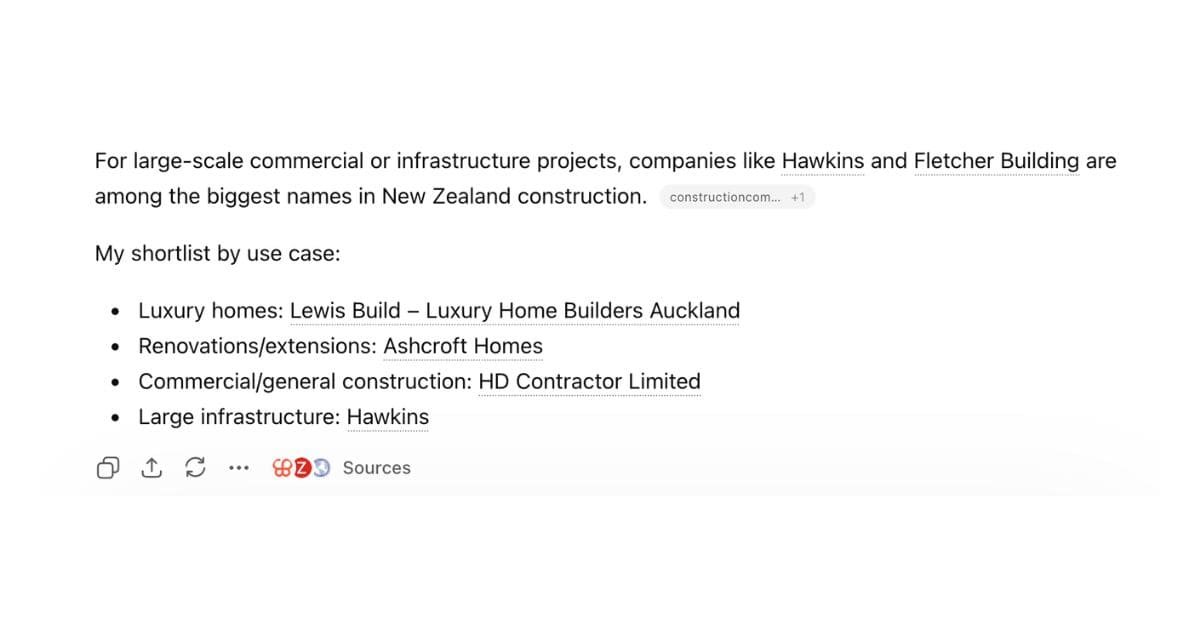
A mention occurs when an AI-generated answer references your brand, product, or expert by name without linking to your site. For example, ChatGPT might answer “What are the best SEO rank trackers?” and include your tool’s name in its response, even without citing your homepage.
Unlinked mentions still matter for AI visibility because large language models form entity associations during training and real-time retrieval. The more your brand name appears in credible contexts – in Reddit threads, YouTube videos, news articles, Wikipedia pages – the more likely an AI model is to associate your entity with the relevant topic cluster and surface it in generative responses.
Why Brand Mentions Now Outperform Backlinks in AI Search
The traditional SEO equation – more authoritative backlinks = higher rankings – still applies to Google’s core algorithm. But AI citation logic uses a different signal set.
An Ahrefs study of 75,000 brands (December 2025) found:
| Signal | Correlation with AI Citations |
|---|---|
| YouTube mentions | ~0.737 (strongest signal) |
| Reddit mentions | High |
| Wikipedia presence | High |
| LinkedIn presence | Moderate |
| Domain Rating (backlinks) | ~0.266 (weak) |
The gap between YouTube mentions (0.737) and Domain Rating (0.266) is significant. This is not because backlinks are useless – they remain the primary signal for Google’s traditional ranking algorithm, which still drives 92% of AI Overview source selection. The insight is that once you’re in the eligible pool for AI citation, brand presence in community and social contexts is what tips the selection.
A brand that ranks #7 for a query but has active YouTube content, Reddit discussions, and Wikipedia coverage will often be cited over a brand that ranks #3 but exists only on its own domain.
How to Earn More Citations in AEO
1. Structure Content for Direct Extraction
Google’s Featured Snippet algorithm selects passages that provide a complete, standalone answer. The same logic applies to AI Overviews.
For AEO-optimised content:
- Place a direct, 40–55 word answer immediately after the relevant H2 or H3
- Open the answer with the keyword or a definition pattern: “X is…”, “X refers to…”, “To X, you…”
- Avoid filler openers like “Great question” or “In this article…”
- Follow with 2–4 sentences of supporting context
For list-based queries, use an <ol> or <ul> directly under the heading, with 5–9 items of 12 words or fewer each. For comparison queries, use a <table> with a clear header row and no more than 4 columns.
2. Write Citation-Ready Passages (GEO)
For AI Overviews and generative platforms, the optimal passage length for citation is 134–167 words. Each section should:
- Be self-contained – answerable without requiring context from other sections
- Open with the subject, not “It” or “This” (avoid pronoun-heavy openings that lose context when extracted)
- Include specific statistics, data points, or original examples – vague generalities are rarely cited
- Attribute claims to named sources (“According to [source]…” or “A 2025 study found…”)
3. Implement Structured Data
Schema markup does not directly cause citations, but it reinforces the semantic signals that influence selection. For AEO and GEO:
- Use Article or BlogPosting schema with author, datePublished, and dateModified
- Add speakable schema pointing to your top answer passages (useful for Google Assistant and AI Overviews)
- Use Organisation schema with sameAs properties linking to your Wikipedia page, LinkedIn, and social profiles
- Avoid FAQPage schema on commercial sites – Google restricted this to government and healthcare authority sites in August 2023
4. Allow AI Crawlers
Check your robots.txt and confirm these crawlers are allowed:
| Crawler | Platform |
|---|---|
| GPTBot | ChatGPT Search |
| OAI-SearchBot | OpenAI search features |
| PerplexityBot | Perplexity AI |
| ClaudeBot | Anthropic / Claude |
| Google-Extended | Google AI features |
If AI crawlers are blocked – even unintentionally through broad wildcard rules – your content is invisible to those platforms regardless of how well it’s written.
5. Add llms.txt
The emerging llms.txt standard provides AI crawlers with a structured map of your most important content. Place a plain-text file at /llms.txt on your domain using this format:
# Your Site Name
> Brief description of what your site covers

## Key pages
- [Page title](url): One-line description
- [Page title](url): One-line description
This is particularly useful for sites with large content libraries where AI crawlers may not surface the most relevant pages through standard crawl paths.
How to Earn More Mentions in AEO and GEO
Build Entity Presence Beyond Your Own Domain
The platforms most likely to generate AI citations are Reddit, YouTube, and Wikipedia. These three channels account for a disproportionate share of both ChatGPT and Perplexity citations.
Reddit: Participate in relevant subreddits where your expertise applies. Answer questions directly – do not just drop links. Authentic participation generates the kind of community-validated content that Perplexity and ChatGPT cite. A thread discussing your tool, product, or methodology is worth more to AI citation signals than most guest posts.
YouTube: Publish content where your brand name and core topics are mentioned in titles, descriptions, and transcripts. YouTube is the single strongest predictor of AI citation visibility in the Ahrefs data. Even a small channel with well-titled, topically relevant videos builds the YouTube mention signal.
Wikipedia: Wikipedia’s presence in both ChatGPT (47.9% of sources) and Perplexity citation pools makes it the single most valuable third-party citation source. If your brand, product, or founding team is notable enough to meet Wikipedia‘s inclusion standards, a Wikipedia article substantially increases AI mention rates.
Pursue Coverage in High-Authority Publications
News coverage, industry blog mentions, and expert roundups generate the kind of third-party, editorially uncontrolled mentions that carry strong AI citation weight. This is the bridge between traditional PR and GEO: getting mentioned in TechCrunch, G2, Product Hunt, or a respected industry newsletter teaches AI models that your entity is associated with the relevant topic.
Build a Consistent Entity Footprint
AI models form entity associations across training data and real-time retrieval. Consistent use of your brand name – not variations or abbreviations – across all platforms strengthens the association. Your Organisation schema, your LinkedIn company page, your Crunchbase listing, and your Google Business Profile should all use the exact same entity name.
Inconsistency (e.g., “ExampleCo” on your website, “Example Co.” on LinkedIn, “Example Corporation” on Crunchbase) weakens entity recognition across AI systems.
| Dimension | AEO Citation | GEO Citation |
|---|---|---|
| Format | Extracted passage shown in SERP | Inline link or footnote in AI response |
| Selection Logic | Best direct answer for exact query | Multi-source synthesis, passage quality |
| Ranking Dependency | High — usually requires top-10 ranking | Partial — quality passages can be cited from lower ranks |
| Schema Benefit | High (speakable, Article, Organization) | Moderate (author, datePublished reinforcement) |
| Community Signals | Low direct impact | High — Reddit, YouTube, Wikipedia strongly influence |
| Content Length Sweet Spot | 40–55 words for paragraph snippet | 134–167 words per citable section |
| JS Rendering | Google handles JS | AI crawlers do NOT render JS — SSR required |
Measuring Your Citation and Mention Performance
Traditional rank trackers show keyword positions. AEO and GEO require a different measurement framework:
For AEO: Monitor Featured Snippet and PAA ownership through Google Search Console (track queries with position 0 indicators) or rank tracking tools that flag SERP feature wins.
For GEO: AI search visibility tracking is an emerging capability. The core metrics to monitor are: how often your brand or domain is cited in responses from ChatGPT, Perplexity, and Google AI Overviews for your target queries; the share of voice your brand has in those platforms compared to competitors; and the volume of brand mentions appearing on high-citation-weight platforms like Reddit and YouTube.
Tools like SearchUp Lab are designed for exactly this dual tracking problem – monitoring both traditional SERP rankings and AI search visibility from a single dashboard, so you can see how your citation and mention footprint is growing across both traditional and generative search.
Common Mistakes That Hurt Citation and Mention Potential
Blocking AI crawlers. A Disallow: / rule, or overly aggressive bot-blocking configurations, will exclude your content from all AI-generated results regardless of quality.
JavaScript-only content. If your key passages are loaded by JavaScript and not present in the server-rendered HTML, AI crawlers will never see them. Generative AI crawlers do not execute JS.
Vague, general statements. AI models cite specific, verifiable claims. Content that says “many studies show” or “experts agree” without naming the study or expert is far less likely to be selected than content with specific, attributed data points.
Inconsistent entity naming. Fragmented entity presence across platforms confuses AI systems trying to match your brand to a topic cluster.
No author or date information. Anonymous, undated content is treated as low-E-E-A-T by both Google and generative AI systems. Every article should have a named author with credentials, a publication date, and a last-updated date.
Ignoring community platforms. Building high-quality content on your own domain but having zero presence on Reddit, YouTube, or Wikipedia leaves most of the AI citation opportunity untapped.
What to Do Now
Citations and mentions in AEO and GEO are the currency of AI search visibility. They are earned through a combination of content structure (for direct extraction), technical accessibility (for AI crawlers), authority signals (for E-E-A-T), and community presence (for brand mention weight).
The practical action list:
- Audit your robots.txt – confirm GPTBot, PerplexityBot, and ClaudeBot are allowed
- Add llms.txt to your domain root
- Restructure key pages with 40–55 word answer blocks after every question-phrased H2
- Write self-contained 134–167 word sections optimised for AI passage citation
- Add Article schema with author, datePublished, and dateModified
- Add speakable schema pointing to your top answer passages
- Build a consistent entity presence on Reddit, YouTube, and LinkedIn
- Pursue Wikipedia coverage if your brand meets inclusion criteria
- Standardise your entity name across all platforms
- Track both SERP rankings and AI visibility to measure what’s working
The brands that will dominate AI search over the next few years are those that treat citations and mentions as deliberately earned assets – not byproducts of traditional SEO.